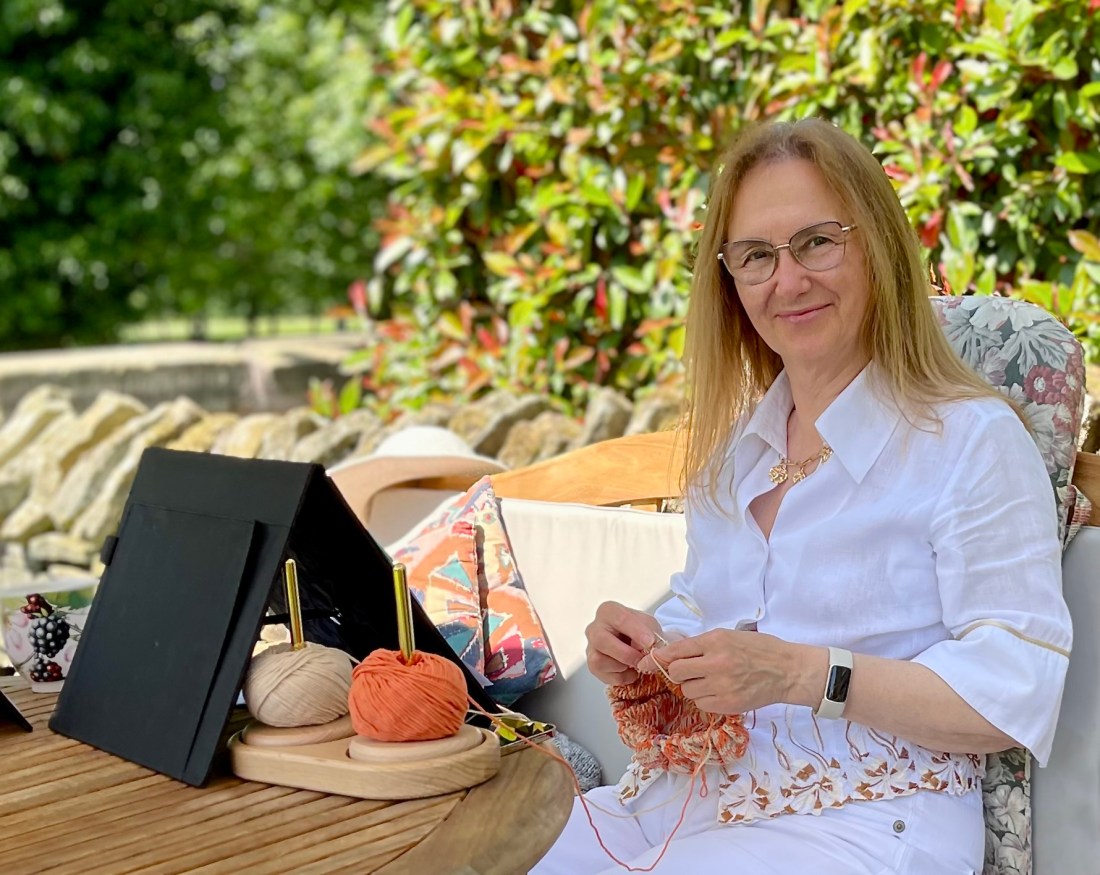
The annual TKGA Design Contest was announced in April 2025 with the title Pillow Talk. I decided to participate, because for a long time I’d had an idea for a cushion in biscornu shape. As for the pattern design, I considered something in damask style to match the upholstery fabric on our own sofas. I looked through my archives and found a sketch I’d made fifty years ago.

50 years ago
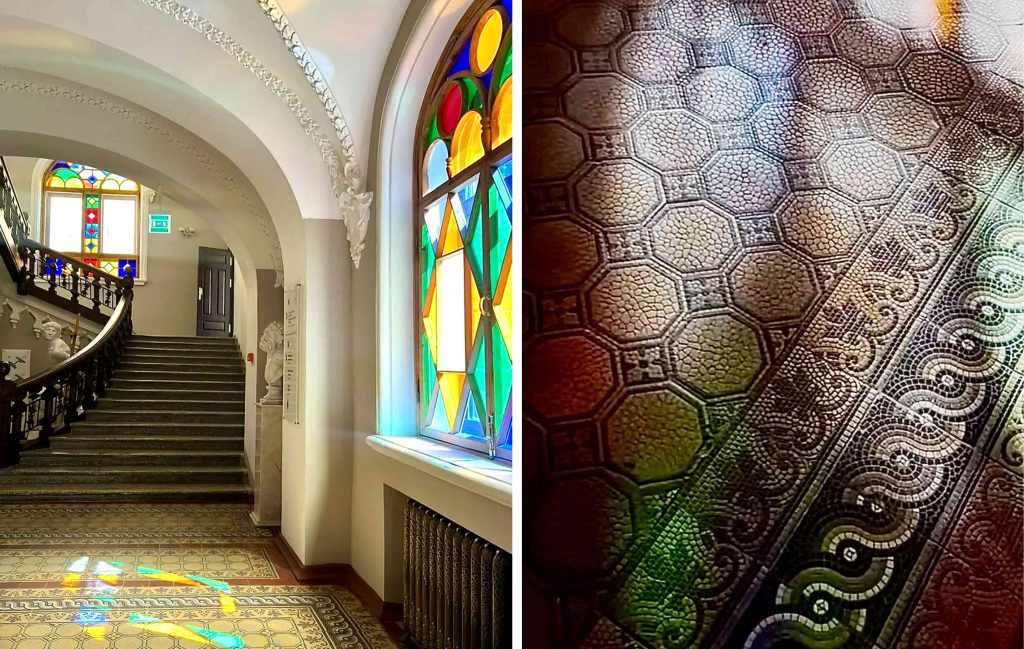
In 1975 I studied at Kazan Technical University. Some lectures took place in a particularly fine old building, and I fell in love with its beautiful floor tiles. I sketched the pattern with the intention to convert it into knitting one day. When I looked at my sketches again after 50 years, it became clear this was the ideal choice for my cushion project.
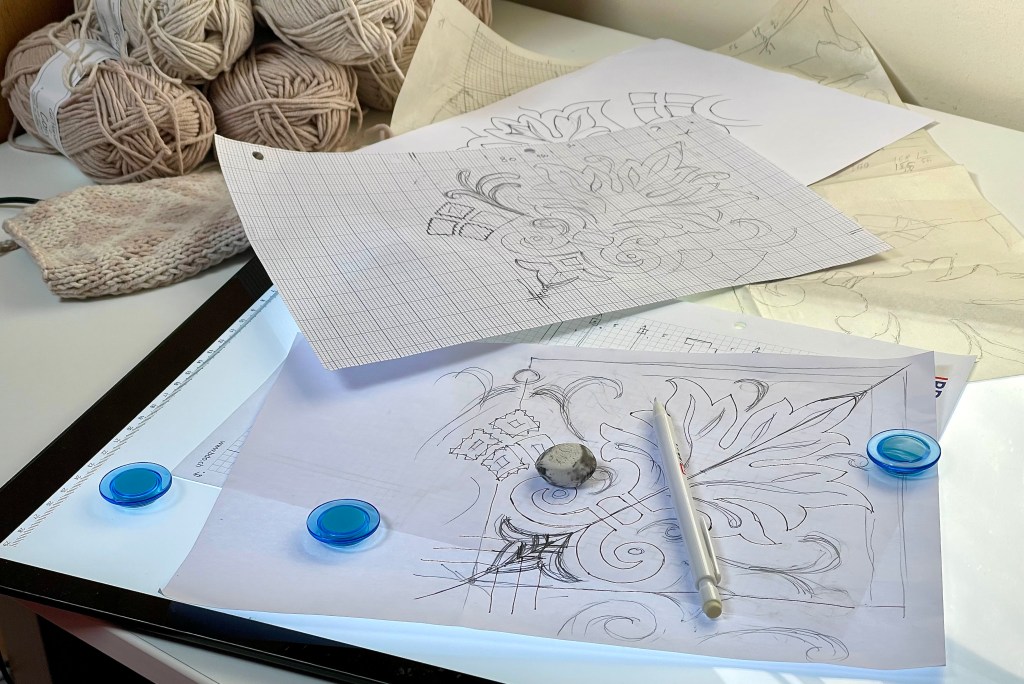
While redrawing the sketch and creating the cell diagrams for knitting, I wanted to learn more about the building and the tiles used. I searched the internet and discovered many fascinating details.
125 years ago
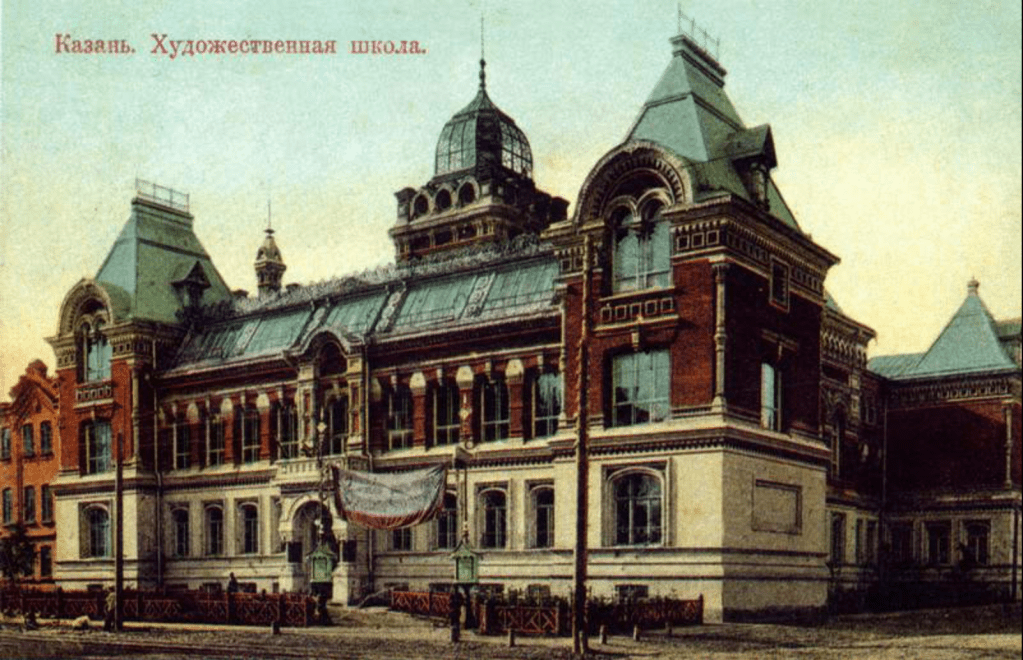
The old building is The Kazan Art School (Republic of Tatarstan): one of the oldest art schools in Russia, with a continuous history of 130 years. The school was founded in 1895 as a branch of the Imperial Academy of Art. Early graduates included Pavel Benkov, Alexander Grigoriev, and Nikolai Fechin, after whom the school is now named.
The construction of the Kazan Art School began in 1900, and the architect was the head of the school itself, Karl Ludwigovich Müfke. It was recognised as an important monument of urban development and architecture. The dark red brick walls of the upper floors, contrasted with the light cream stones of the ground floor. The floors inside were parquet and Mettlach tiles. I started looking for information about the tiles themselves.
173 years ago
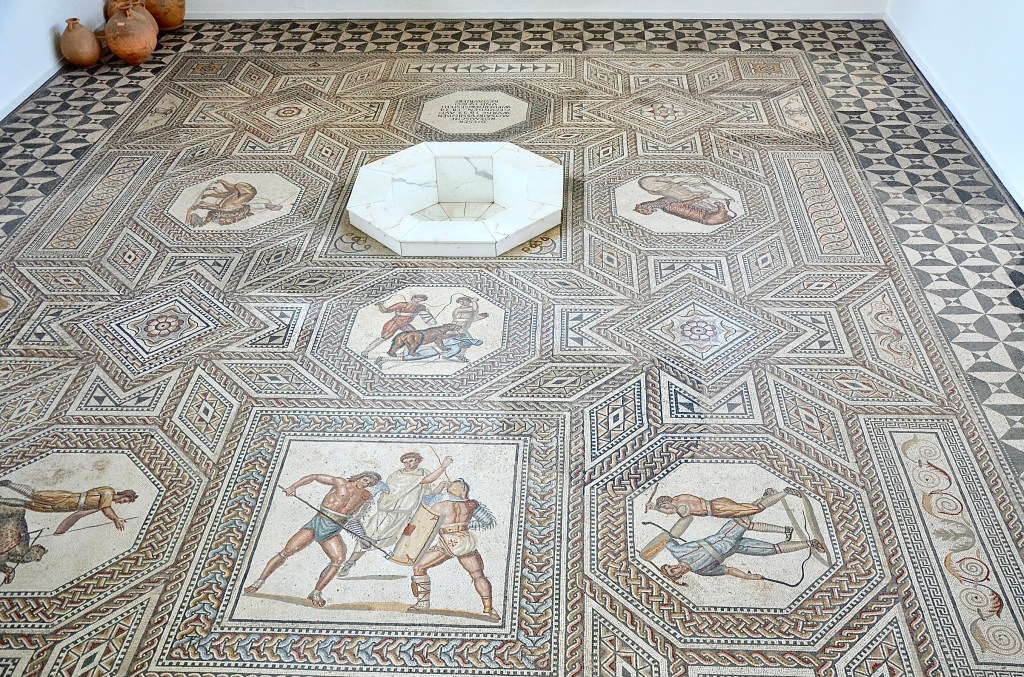
In 1852 a farmer in Nennig, Germany, uncovered a part of a Roman mosaic. Eugen Boch, from the Boch family of Villeroy and Boch, participated in archaeological excavations and was entrusted with restoration of the mosaic. Inspired by the beauty of the mosaic, Boch developed a designs for tiles imitating the structure of ancient Roman mosaics and patterns. Villeroy and Boch began experimenting with materials for tile manufacture, and developed a production process which combined wear resistance with a beautiful appearance.
The tiles were produced in their factory in Mettlach, Germany. These Mettlach Tiles achieved great success and were internationally recognised for their strength, practicality and beauty. They can be seen in palaces and prestige buildings, churches and theatres, and were even used in the Titanic.
2000 years ago
The inspiration for Mettlach tiles was the ancient mosaic floor decorating the atrium of the magnificent Roman villa, located in Perl-Nennig, south of Trier, which been dated by archeologists as around 175AD.The floor depicts scenes from a Roman amphitheatre.
During this research I managed to find this leaf pattern in Mettlach Tiles Catalogue.

After these discoveries, the choice of colours for my cushion was very easy: terracotta leaf details and the light stone colour background. To achieve the decorative effect of the mosaic surface, I developed a new method, based on Inlay technique, which I called Showy Floats. The Biscornu Cushion pattern fully describes Showy Floats, as well as some of my other innovations. The pattern is published on TKGA platform Circle, and is freely available for registered TKGA members.

The beautiful leaves decorate the corners of the Biscornu cushion squares. Thus these ancient Roman designs and patterns have lived on through the ages.
 Assia Brill
This was absolutely fascinating – thank you, Assia! I learnt so much, and of course your design is beautiful (as they all are 💐). Many, many congratulations on first prize! 👏🏾👏🏾👏🏾
LikeLiked by 1 person
Thank you Natalie! Glad you like it.
LikeLiked by 1 person
Brava! A wonderful piece with a rich history, and another example of your meticulous design and execution. A well-deserved win.
LikeLiked by 1 person
Dear James, so glad to hear from you! Thank you so much!
LikeLike