
Cables are one of the most beautiful and exciting stitch techniques, and they can be very simple or very complicated. Their main features are the branches which twist around each other or move over the background. These branches usually start (and finish) suddenly, growing upwards. Sometimes the end of the branch is hidden under another branch.
Motifs with a rounded start (and end), where the branches are connected together, are less common. To start them, knitters use increases (and decreases for the end) to achieve the desired form. Such cables are called either eternity cables, closed-ring cables or сlosed-loop cables.
Infinite or endless-loop motifs echo classic knot-work designs, which have ancient roots. Elaborate interlacing is found in Celtic, Roman, Islamic, Coptic, and Norse art. Knot motifs may have deep symbolic meaning, or they are used as decorative elements. For knitters, knot motifs are great fun to design and to knit.
I started to work on circular cables in 2016 by first studying existing methods. To create the cable pattern, which starts with rounded horizontal section, you are normally asked to work five stitches from one stitch, at once or in two steps. Here are a few common increasing methods: M1, CDI, M1 (1); two double increases (2), Christmas Tree increase (3) developed by Christine Guest. Here are the first article 2008 and updated instructions 2015.

To finish the cables with a rounded top section, these extra stitches now need to be decreased. Here there are many possibilities too: bunch decrease k5tog (4); two double decreases (5); a very good method by Barbara Walker (6), when 4 side stitches are simply hung on the central stitch, alternating on the left, and on the right.
Of course there are many other variations, depending on what type of increase is made. Some amazing designs are by Lucy Hague, Ann Kingstone and others. A few designers were not satisfied with the appearance of the standard established methods, and did their best to improve them.
These methods give the impression of a semi-circular shape, but they don’t make it perfectly smooth. Therefore I decided not to imitate, but actually make this shape. After many experiments and trials I managed to create ideal circular ring, but at a cost: it is not a quick process. Its perfect shape is achieved with the help of High Relief Cables (HRC), plus a few other techniques: Turkish cast-on, I-cord, Twincrease and grafting stitch. To create the really rounded curves of the ring, the cables sometimes are worked in every row, on right and wrong sides of the knitting. All this puts these complex cables in the advanced category, 4 stars difficulty out of 5.
After I perfected the shape of the ring, I tried the other relatively easy shapes like number 8, hearts, Solomon’s knots:

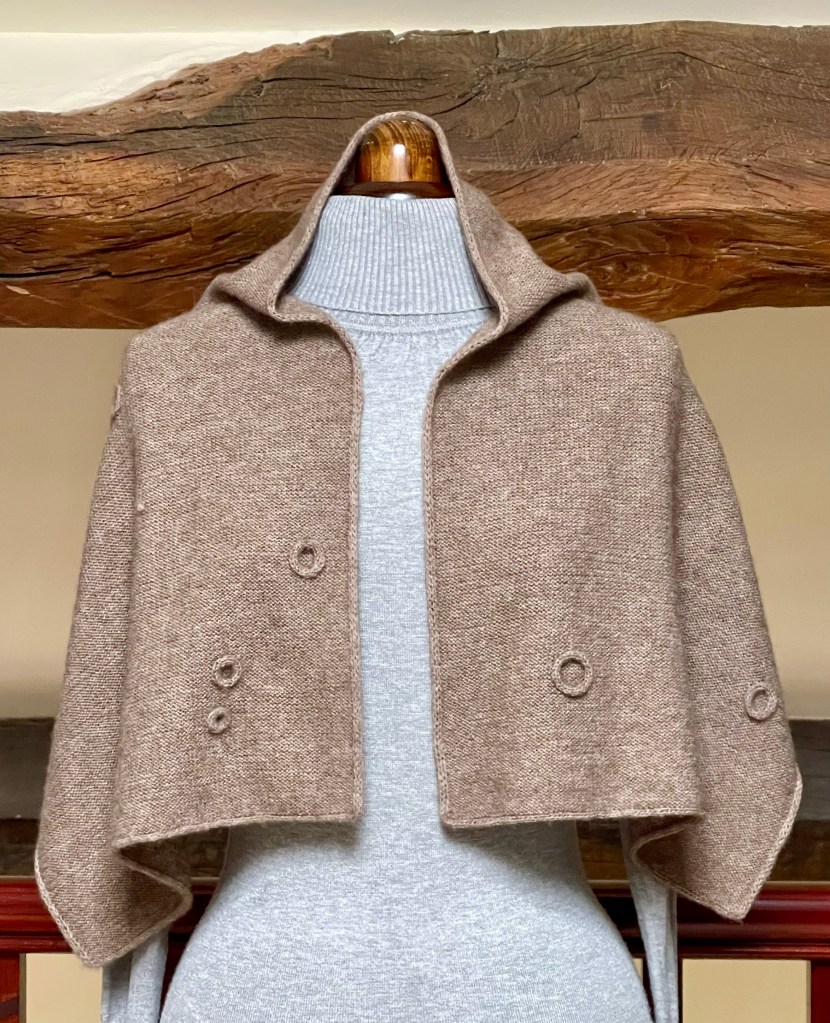
TriTaurus Scarf scarf was designed to show the advantages of the new Ring Cables technique. This scarf with all around I-cord edges, has a long rectangular shape, and 14 Ring cables represent the stars of the Taurus constellation. The new pattern is published on Ravelry.
 Assia Brill